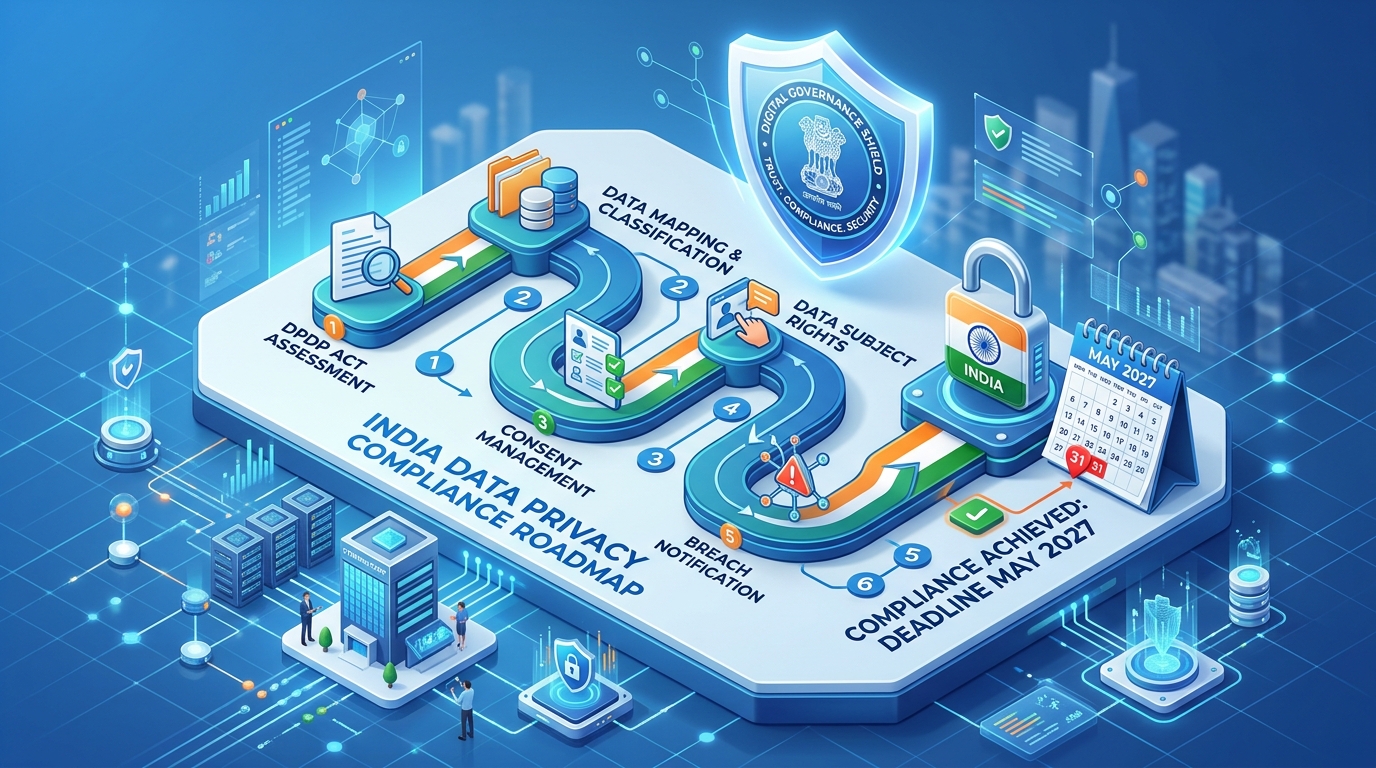
The Countdown to May 2027 Has Begun
With the notification of the
Digital Personal Data Protection Rules, 2025, India's data protection regime has transitioned from legislative theory into operational reality. The Data Protection Board of India (DPBI) is now active, and organisations have an 18-month transition window before full statutory penalties (up to ₹250 crore per violation) take effect.
For Data Fiduciaries operating in India, the question is no longer
if they must comply, but
how fast they can build defensible compliance infrastructure.
---
5 Critical Deadlines Every CIO and DPO Must Track
1.
Section 5 Notice Alignment (Month 1–3): Every customer, user, and employee data capture point must be upgraded to deliver clear, multilingual notices in English and all 22 Eighth Schedule languages.
2.
Consent Manager Architecture (Month 4–6): Systems must integrate interoperable APIs to honour consent registrations and withdrawals mediated through registered Consent Managers.
3.
Data Discovery & RoPA Baselining (Month 7–9): Automated scanning across relational databases, cloud storage buckets, and third-party SaaS tools to detect India-specific identifiers (Aadhaar, PAN, UPI ID, Voter ID).
4.
Breach Incident Vault & Dual-Clock SLAs (Month 10–12): Establishing workflows capable of notifying CERT-In within 6 hours and DPBI within 72 hours of discovering a personal data breach.
5.
Significant Data Fiduciary (SDF) Obligations (Month 13–18): Appointment of an India-resident DPO, conducting periodic Data Protection Impact Assessments (DPIAs), and commissioning independent annual data audits.
---
The Cost of Waiting: Why Retroactive Remediation Fails
Organisations that defer compliance until Q1 2027 will face immense resource bottlenecks. Retrofitting consent records across millions of legacy user accounts requires engineering refactors, schema migrations, and legal redlines with hundreds of data processors.
By establishing an all-in-one compliance operating system today, Indian enterprises turn compliance from a reactive legal burden into an enterprise trust asset.