

E-Commerce & Retail12 min read•September 2026

DPDPA Compliance for E-Commerce & Retail in India: The Definitive 2026 Operational Guide

Master DPDPA compliance for e-commerce in India. Navigate Draft DPDP Rules, the 3-year data retention mandate, cart consent, 3PL vendor risks, and DSR automation.

Adv. Rajesh Sharma

Adv. Rajesh Sharma

Verified Legal Counsel

Lead Privacy Counsel & CIPP/E • PrivacyOS Legal & Tech Desk

DPDPA Compliance for E-Commerce & Retail in India: The Definitive 2026 Operational Guide
Key Takeaways for Indian E-Commerce Leaders (TL;DR)
  • 3-Year Retention Purge: Platforms with >2 crore users must enforce a strict 3-year data deletion schedule from the customer's last active interaction.
  • Unbundled Checkout Consent: Bundling marketing newsletters, SMS promos, or retargeting pixels with the "Place Order" button is strictly illegal under Section 6.
  • Zero Minor Profiling: Section 9 completely prohibits behavioral tracking, heatmaps, and targeted advertising for users under 18, even if parents consent.
  • 3PL Courier Liability: Under Section 8(2), brands remain primarily liable for customer data leaks occurring across logistics couriers and payment aggregators.
  • Dual-Clock Escalation: Mandatory reporting within 6 hours to CERT-In for cybersecurity incidents, and 72 hours to DPBI for personal data breaches.

Executive Summary: The End of Unchecked Tracking in Indian E-Commerce

India's digital commerce landscape has crossed an irreversible regulatory threshold. The notification of the Digital Personal Data Protection Act (DPDPA), 2023 (Act No. 22 of 2023) alongside the Draft Digital Personal Data Protection Rules, 2025 published by the Ministry of Electronics and Information Technology (MeitY) has dismantled the industry's historical reliance on bundled consents, dark-pattern checkout funnels, and perpetual customer data retention.

For online retail enterprises—spanning direct-to-consumer (D2C) brands, omnichannel retail chains, quick-commerce operators, and multi-vendor marketplaces—personal data is the engine of commercial growth. Every customer interaction, from cart abandonment retargeting to 3PL logistics routing, involves the ingestion and processing of digital personal data.

Under DPDPA, e-commerce platforms are designated as Data Fiduciaries. This designation imposes strict, non-negotiable statutory duties:
  • Notice & Purpose Limitation (Section 5): Unambiguous, standalone notices in English and all 22 Eighth Schedule languages before collecting any customer information.
  • Granular Consent Architecture (Section 6): An absolute ban on pre-ticked checkboxes and bundled marketing opt-ins at checkout.
  • Verifiable Parental Consent (Section 9): Strict age-gating and an outright ban on behavioral tracking and targeted advertising for users under 18.
  • Third-Party Processor Liability (Section 8(2)): Full legal and financial accountability for customer data leaks occurring across third-party logistics (3PL) couriers and payment gateways.
  • Dual-Clock Incident Reporting: Synchronizing CERT-In's 6-hour cybersecurity reporting clock (Directions No. 20(3)/2022-CERT-In) with DPBI's 72-hour personal data breach notification requirement.
  • With statutory financial penalties reaching ₹250 crore per violation, data privacy is no longer a peripheral legal formality. It is now a board-level operational imperative that dictates modern commerce architecture.

    Explore how the PrivacyOS E-Commerce & Retail Compliance Suite enables transaction-speed privacy controls across Shopify, Magento, WooCommerce, and headless commerce stacks.

    ---

    The 5 Governed Data Streams Across the E-Commerce Lifecycle

    E-commerce businesses process customer data through diverse systems, microservices, and external vendor APIs. Under the DPDP Act, organizations must systematically identify, classify, and govern five core data streams:

    Data Stream Specific Identifiers System Touchpoints Statutory Risk & Mandate
    1. Identity & Accounts Name, mobile, email, password hash, demographic profile, KYC documents Storefront sign-up, customer portal, SSO Critical Risk: Section 5 notices, purpose limitation, user deletion rights.
    2. Transactions & Payments Order history, invoice line-items, tokenized payment references, UPI VPAs, refunds Payment gateways (Razorpay, Cashfree), ERPs, ledgers High Risk: Conflict between DPDPA Section 12 erasure and GST Act 72-month tax retention.
    3. Behavioral Telemetry & Ad Tech Clickstream logs, search queries, wishlists, ad cookies, device fingerprints Meta Pixel, Google Tag Manager, CDPs (Segment, RudderStack) Very High Risk: Strict ban on tracking minors (<18); unbundled marketing opt-in required.
    4. Fulfillment & Logistics Delivery addresses, GPS coordinates, landmark notes, recipient contact numbers 3PL couriers (Delhivery, BlueDart, Shadowfax), WMS High Risk: Mandatory Section 8(2) DPAs and downstream courier erasure SLAs.
    5. Marketplace Ecosystem Merchant KYC, vendor banking records, seller messages, affiliate tracking IDs Multi-vendor admin consoles, seller onboarding APIs Moderate Risk: Multi-tenant database isolation, access controls, periodic audits.

    ---

    Deep-Dive: 6 Critical Mandates from the Draft DPDP Rules 2025

    1. The 3-Year Retention Mandate for Platforms with >2 Crore Users

    Rule 8 of the Draft DPDP Rules 2025 establishes a specific retention threshold: e-commerce platforms with over two crore (20 million) registered users must enforce a strict three-year data retention schedule, measured from the customer's last interaction or the commencement of the rules, whichever is later.

    This rule introduces two vital operational imperatives for engineering teams:
  • Defining Active Interaction: Tech teams must explicitly define what constitutes an interaction. Under privacy jurisprudence, only active user engagement (such as logging in, placing an order, or actively updating account details) can refresh the retention timer. Automated broadcast marketing does not qualify.
  • Tax Law vs. DPDPA Erasure Conflict: While DPDPA Section 12 mandates personal data deletion upon purpose fulfillment, Section 36 of the Goods and Services Tax (GST) Act mandates keeping invoices for 6 years (72 months). To resolve this, platforms must deploy cryptographic pseudonymization vaults, stripping direct customer identifiers (name, mobile, shipping address) from purchase records while retaining anonymized transaction ledgers for tax compliance.
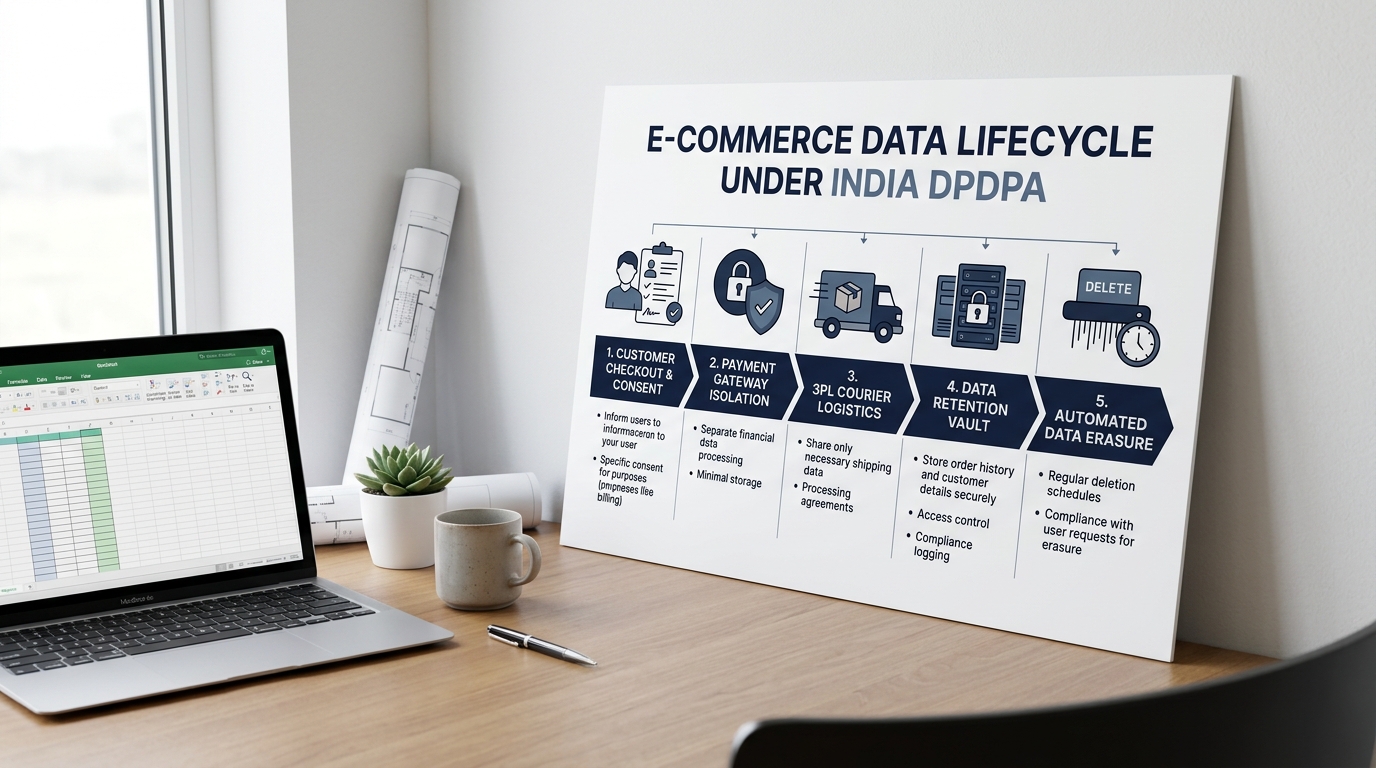
  • E-Commerce Data Lifecycle under India DPDPA

    Figure 1: E-Commerce Customer Data Lifecycle & Regulatory Touchpoints under the DPDP Act 2023 & Draft Rules 2025

    2. Unbundled, Multilingual Consent at Cart & Checkout (Section 5 & 6)

    Monolithic consent forms—where a single click on "Place Order" binds the user to terms of service, marketing newsletters, third-party profiling, and ad retargeting—are illegal under DPDPA.
  • The Granular Opt-In Rule: Transactional processing (delivery and billing) must be decoupled from promotional communications. A customer who provides their mobile number to receive shipping updates cannot be enrolled in promotional WhatsApp broadcasts without an independent, unchecked opt-in.
  • 22 Scheduled Language Parity: Section 5(3) mandates that privacy notices must be accessible in English and all 22 Eighth Schedule languages (Hindi, Tamil, Telugu, Marathi, Bengali, Gujarati, Kannada, etc.). For e-commerce brands driving regional penetration across Tier-2 and Tier-3 Bharat, dynamic language switching at checkout is now mandatory.
  • Deploy high-converting, sub-50ms consent banners with the PrivacyOS Consent Management Module.

    3. Section 9: Verifiable Parental Consent & The Absolute Ban on Tracking Minors

    Section 9 represents the strictest compliance liability in the DPDP Act. Under Indian law, anyone under 18 years of age is legally classified as a child.
  • Total Ban on Behavioral Tracking: Section 9(3) explicitly prohibits tracking the behavior of children or serving them targeted advertisements. This ban applies even if parents provide consent.
  • The Omnichannel Commerce Dilemma: While toys, children's fashion, and gaming brands are directly affected, general e-commerce platforms frequently attract teenage consumers. Platforms must implement age-verification mechanisms (such as tokenized DigiLocker checks or parent-guardian mobile OTP links) before enabling personalized recommendation engines or ad pixels.
  • Review architectural requirements in our comprehensive Section 9 Children's Data Protection Guide.

    4. 3PL Logistics & Vendor Risk Management (Section 8(2))

    E-commerce brands routinely share sensitive customer data with courier partners, payment aggregators, customer support platforms, and analytics SaaS.

    Under Section 8(2), a Data Fiduciary can only share data with a Data Processor under a valid, legally binding Data Processing Agreement (DPA). If a courier partner suffers a data compromise exposing customer phone numbers and residential addresses, the Data Protection Board of India (DPBI) will penalize the e-commerce brand, not just the logistics vendor.

    Partner Category Sample Vendors Data Shared Required DPDPA Safeguards
    Logistics & 3PLs Delhivery, BlueDart, Shadowfax, Shiprocket Name, phone, shipping address, landmark, pin code Masked phone numbers, strict delivery-window retention, zero third-party profiling.
    Payment Gateways Razorpay, Cashfree, PayU, PhonePe Billing name, email, transaction amount, UPI ID PCI-DSS alignment, tokenized card vaults, strict purpose limitation.
    Customer Engagement & CRM Klaviyo, MoEngage, CleverTap, Zendesk Email, phone, browsing history, purchase category Explicit marketing consent proof, unbundled opt-in sync, instant DSR deletion webhooks.
    Cloud & Analytics AWS, Google Cloud, Snowflake, Databricks User profiles, database backups, clickstream raw logs Data localization review, encryption at rest/in transit, strict role-based access control.

    Automate vendor risk audits and DPA enforcement using PrivacyOS Vendor Risk Management.

    5. Dual-Clock Incident Escalation: CERT-In 6-Hour vs. DPBI 72-Hour Mandates

    When a security breach occurs (such as database exfiltration, credential stuffing attacks, or payment API compromises), e-commerce security teams must manage two independent reporting timelines:
  • CERT-In Mandate (Cybersecurity Focus): Mandatory reporting within 6 hours of detecting a cybersecurity incident.
  • DPDPA Section 8(6) (Personal Data Focus): Mandatory reporting of personal data breaches to the Data Protection Board of India (DPBI) and all impacted consumers within 72 hours.
  • Concealing a breach or failing to notify the Board carries statutory penalties of up to ₹200 crore.

    Build automated breach notification workflows with PrivacyOS Breach Response.

    6. Rule 12(3) Algorithmic Audits for Significant Data Fiduciaries

    Large marketplaces and category-leading D2C brands are prime candidates for designation as Significant Data Fiduciaries (SDFs) based on processing volume, sensitivity, and societal impact.

    Under Rule 12(3) of the Draft Rules, SDFs deploying automated decision-making software or recommendation algorithms must undergo periodic independent algorithmic audits to ensure data processing does not cause consumer harm or systemic bias.

    ---

    Special Sector Scenarios: Quick-Commerce & Omnichannel Retail

    The operational impact of DPDPA extends far beyond standard web storefronts. Two fast-growing digital commerce models face immediate compliance refactors:

    1. Quick-Commerce (10-Minute Delivery Models)

    Platforms like Blinkit, Zepto, and Swiggy Instamart ingest high-frequency, continuous geolocation data, building precise real-time lifestyle maps of consumers.
  • Rider Telemetry & Number Masking: Sharing unmasked customer mobile numbers and home addresses with delivery gig-workers creates immense data leakage risks. Platforms must enforce virtualized call masking (via cloud telephony) and restrict riders from viewing customer phone numbers or preserving delivery history on personal devices.
  • Micro-Fulfillment (Dark Store) Data Isolation: Dark-store inventory and dispatch logs containing customer names must be purged within 48 hours of successful delivery, retaining only order reference tokens.
  • 2. Omnichannel Retailers & Physical POS Billing Desks

    Brick-and-mortar retail brands with digital loyalty programs frequently demand customer mobile numbers at billing counters before generating a receipt.
  • The "Mandatory Phone for Bill" Dark Pattern: Under Section 6 of DPDPA and the Ministry of Consumer Affairs Advisory (May 2023), insisting on customer mobile numbers as a mandatory prerequisite for generating a sales invoice is unlawful.
  • Retail cashiers must inform shoppers that phone number submission is strictly optional for loyalty rewards. If a customer declines, the point-of-sale system must issue a paper or anonymous QR-code receipt without collecting PII.
  • ---

    Free Compliance Resource

    Download: 2026 E-Commerce 3PL Courier DPA Clause & Cart Consent Checklist

    Production-ready legal clauses for Delhivery/BlueDart agreements, 22-language checkout notice templates, and automated retention timers for Indian D2C brands.

    Get Free PDF Checklist →

    ---

    DPDPA 2023 vs. EU GDPR: What Global Online Retailers Must Unlearn

    Many international brands expanding into India mistakenly assume that existing GDPR compliance frameworks satisfy Indian law. In reality, key differences create significant compliance gaps:

    Compliance Dimension EU GDPR India DPDPA 2023 & Draft Rules Operational Impact for E-Commerce
    Age of Majority Under 16 years (individual member states can lower to 13) Strictly under 18 years across India Teen fashion, electronics, and gaming e-commerce must implement verifiable parental consent.
    Behavioral Ads for Minors Permitted with parental consent and appropriate safeguards Completely prohibited under Section 9(3) Tracking pixels and personalized recommendation engines must be dynamically deactivated for minors.
    Lawful Grounds for Processing 6 bases (Consent, Legitimate Interest, Contract, etc.) Only 2 bases: Consent & Certain Legitimate Uses "Contractual necessity" and "legitimate business interest" cannot be used to justify marketing profiling.
    Multilingual Notice Official EU languages (typically English + country language) English + 22 Scheduled Indian Languages Storefronts must support dynamic localized consent notices across regional Indian dialects.
    Maximum Statutory Fines €20 Million or 4% of global annual turnover Up to ₹250 Crore per violation Direct statutory penalties levied per incident with no revenue-based liability cap.
    Consent Interoperability Standard Cookie Consent CMPs Interoperable Consent Manager (CM) API support Systems must integrate with MeitY-registered Consent Managers via standardized open APIs.

    ---

    4-Step Technical Architecture for E-Commerce Engineering Teams

    Phase 1: Automated Data Discovery & RoPA Baselining

    Organizations cannot govern data they cannot see. Tech teams must deploy automated discovery connectors across all transactional databases (PostgreSQL, MySQL, MongoDB), cloud object stores (AWS S3, Google Cloud Storage), and data warehouses (Snowflake, BigQuery).
  • Scan for India-specific identifiers: Aadhaar numbers, PAN cards, UPI IDs, mobile numbers, and physical delivery coordinates.
  • Maintain an automated Record of Processing Activities (RoPA) documenting purpose, storage location, and third-party recipients.
  • Deploy PrivacyOS Automated Data Discovery to continuously scan data repositories without impacting query latency.
  • Phase 2: Refactoring Checkout Funnels with Purpose-Linked Consent

    Replace all legacy single-checkbox checkout screens with an unbundled, purpose-linked consent structure:
  • Core Order Fulfillment: Bundled strictly for order fulfillment, delivery, and invoice generation.
  • Promotional Marketing (SMS, WhatsApp, Email): Optional, unbundled checkbox defaulted to unchecked.
  • Third-Party Behavioral Retargeting: Managed through an upfront Cookie Consent Banner that blocks ad tags until explicit user consent is recorded.
  • Phase 3: Deploying Self-Service DSR Automation

    Under Section 11, 12, and 13, Indian consumers have legal rights to Access, Correction, Erasure, and Grievance Redressal.
  • Handling deletion requests via manual customer support emails creates severe operational overhead and human error risks.
  • Platforms must deploy an OTP-authenticated self-service DSR portal. When a customer requests account deletion, the system verifies active order status, purges marketing profiles (Klaviyo, CleverTap), anonymizes order history, and issues a cryptographic audit receipt.
  • Integrate PrivacyOS DSR Automation to resolve customer deletion requests in minutes while maintaining audit-defensible logs.
  • Phase 4: Enforcing 3PL Vendor DPAs & Retention Timers

  • Execute updated Data Processing Agreements with all logistics partners. Restrict couriers from retaining customer contact lists or utilizing shipping telemetry for external market intelligence.
  • Configure automated retention timers: purge abandoned cart sessions older than 90 days, and archive transaction records into encrypted, pseudonymized vaults for tax compliance.
  • ---

    Accelerate Your DPDPA Compliance with PrivacyOS Global

    Achieving compliance does not mean sacrificing checkout conversion rates or marketing efficacy. Modern Indian brands use privacy governance as a brand differentiator that builds enduring customer loyalty.

    PrivacyOS Global is India's leading unified privacy operating system, engineered specifically for high-velocity digital businesses:
  • Zero-Latency Consent Management: Deploy dynamic, 22-language consent notices and cookie governance banners with lightweight SDKs for Shopify, WooCommerce, and headless React/Next.js storefronts.
  • Automated DSR Workflows: Resolve customer erasure and access requests in minutes with OTP verification and bi-directional API connectors.
  • Enterprise Data Discovery: Continuously discover and map PII across PostgreSQL, MongoDB, Snowflake, AWS S3, and CRM tools.
  • Vendor Risk & DPA Tracker: Monitor 3PL logistics and marketing vendors with automated SLA audits and standardized DPA templates.
  • Take the next step in enterprise compliance: Review our comprehensive Top DPDPA Compliance Platforms Comparison or schedule a tailored DPDPA Gap Assessment with our certified privacy architects.

    Frequently Asked Questions

    Does the DPDPA apply to small D2C brands or only large marketplaces?

    Yes. The DPDPA applies to any entity processing digital personal data in India, regardless of annual turnover or company size. While only large platforms may be designated as Significant Data Fiduciaries (SDFs) with additional audit requirements, all online sellers must comply with core obligations: 22-language consent notices, purpose limitation, DSR rights handling, and breach reporting.

    Can e-commerce companies send WhatsApp order updates without explicit marketing consent?

    Yes, for transactional updates. Sending order confirmations, OTPs, tracking numbers, and delivery alerts is part of contract fulfillment and does not require separate marketing consent. However, using the same WhatsApp channel to send promotional discounts, new product launches, or cross-sell recommendations requires explicit, unbundled marketing opt-in consent under Section 6.

    How long can online retailers retain customer order history?

    Under DPDPA Section 12, personal data must be erased as soon as the specified purpose of collection is fulfilled or consent is withdrawn. For tax, accounting, and warranty obligations under the GST Act and Companies Act, retailers may retain transaction financial logs for 6 to 8 years. However, customer identity and delivery records must be pseudonymized or stripped of unnecessary identifiers once the delivery and return window closes.

    Are cookie banners mandatory for Indian e-commerce websites?

    Yes. If your website uses tracking pixels, advertising tags (Meta Pixel, Google Analytics, LinkedIn Insight), or behavioral profiling tools that collect personal device identifiers, IP addresses, or browsing history, you must obtain prior consent via a compliant cookie banner before activating those scripts.

    How should e-commerce platforms verify parental consent for customers under 18?

    Under Section 9 and the Draft Rules, platforms processing minors' data must obtain verifiable parental consent. Mechanisms include linking the child's profile to an OTP-authenticated parent account, tokenized guardian verification through DigiLocker, or government-backed ID verification. Platforms must also ensure that all behavioral profiling and targeted advertisements are disabled for accounts identified as minors.

    Tags:#DPDPA#E-Commerce#Draft DPDP Rules#Data Retention#Vendor Risk#Retail Compliance
    STAY AHEAD OF DPDPA RULES

    Prepare Your Systems For The 2027 DPBI Enforcement

    Evaluate consent banners, DSR portals, vendor DPAs, and data discovery with an interactive PrivacyOS platform walkthrough.