
India's financial technology and banking ecosystem is globally celebrated as the benchmark for real-time digital architecture—processing over 14 billion monthly UPI transactions, scaling instantaneous digital onboarding via Video KYC (V-KYC), and enabling real-time micro-lending through the Account Aggregator (AA) framework. However, beneath this speed lies unprecedented statutory exposure.
Financial entities—ranging from Scheduled Commercial Banks (SCBs) and Non-Banking Financial Companies (NBFCs) to Payment Aggregators (PAs), Neo-banks, and WealthTech platforms—handle India's most sensitive personal datasets: Permanent Account Numbers (PAN), Aadhaar tokens, bank account statements, repayment histories, device telemetry, and biometric authentication proofs.
The Dual-Regulator Reality for Indian BFSI
With the operationalization of the Digital Personal Data Protection Act (DPDPA) 2023 and the DPDP Rules 2025/2026, financial institutions operate under two intersecting authorities: sectoral regulators (RBI, SEBI, IRDAI) focused on financial stability and anti-money laundering (PMLA), and the Data Protection Board of India (DPBI) enforcing individual privacy autonomy, purpose limitation, and the Right to Erasure. A violation under Section 33 invites statutory penalties up to ₹250 Crores per incident.
The Dual-Regulator Trap: DPDPA 2023 vs. RBI Master Directions & PMLA
A critical misconception among fintech engineering and compliance teams is that existing certification under ISO 27001 or adherence to RBI's Master Direction on Information Technology Governance (2023) satisfies DPDPA requirements. This assumption creates massive legal vulnerability. RBI rules govern information security controls (confidentiality, integrity, availability), whereas DPDPA governs informational privacy rights (purpose limitation, consent granularity, and consumer data autonomy).
| Regulatory Domain | Sectoral Mandate (RBI / PMLA / SEBI) | Data Privacy Mandate (DPDPA 2023) | Harmonized Operational Strategy |
|---|---|---|---|
| Legal Basis for Processing | Statutory compulsion (Mandatory KYC under Section 12 PMLA, RBI KYC Master Direction 2016). | Free, specific, informed, unconditional consent (Section 6), or Certain Legitimate Uses (Section 7). | Bifurcate data: Core statutory KYC is processed under Section 7/law, while marketing/cross-sell requires explicit Section 6 consent. |
| Data Retention Period | Mandatory retention of customer identity and transaction logs for minimum 5 to 10 years. | Data must be erased once specified purpose is fulfilled or upon consent withdrawal (Section 8(7) & Section 12). | Deploy Dual-Tier Archival Architecture: Detach PII from active databases and lock in an encrypted statutory cold vault. |
| Data Storage Location | All payment data and core banking records must reside strictly in India (RBI April 2018 Directive). | Permits cross-border transfer unless to a blacklisted jurisdiction (Section 16). | RBI strict localization supersedes DPDPA. Core financial and payment data must remain 100% inside India (AWS ap-south-1). |
| Breach Notification | Report to RBI within 2 to 6 hours; report to CERT-In within 6 hours of detection. | Intimate the Data Protection Board and affected users within 72 hours (Section 8(6)). | Unified Incident Triad: Immediate 6-hour CERT-In/RBI notification, followed by parallel forensic user notice package. |
Reconciling Right to Erasure (Sec 12) with Mandatory 5-Year Statutory Retention
The single most contested architectural question for Fintech CISOs and legal counsels is: When a customer closes their credit line or deletes their wallet and submits a Right to Erasure request under DPDPA Section 12, are you legally obligated to wipe their records?
The answer is No—with a critical architectural caveat. Under Section 12(3) of DPDPA 2023, erasure is mandatory "unless retention of the personal data is necessary for compliance with any law for the time being in force." Simultaneously, Section 12 of the Prevention of Money Laundering Act (PMLA) 2002 and Section 38 of the RBI Master Direction on KYC mandate that financial entities maintain customer identification data and transaction logs for 5 years following account termination.
The Fatal Compliance Mistakes Most Fintechs Make:
- The Total Wipeout Mistake: Dropping user rows across production databases to satisfy DPDPA DSAR requests—violating PMLA Section 12 and triggering RBI audits and potential NBFC license cancellation.
- The Blanket Rejection Mistake: Denying the erasure request completely citing RBI guidelines, but continuing to hold customer numbers in marketing databases, re-targeting algorithms, and WhatsApp promotional lists—violating DPDPA Section 8(7) and risking a ₹250 Crore penalty.
Engineering Dual-Tier Cold Vault Architecture for Financial Entities
To resolve the conflict between DPDPA Section 12 erasure and PMLA statutory retention, engineering teams must implement a Dual-Tier Archival Pipeline. When a customer invokes erasure, active transactional systems purge the data immediately, while a cryptographically locked statutory vault retains the minimal necessary audit trail for regulatory compliance.
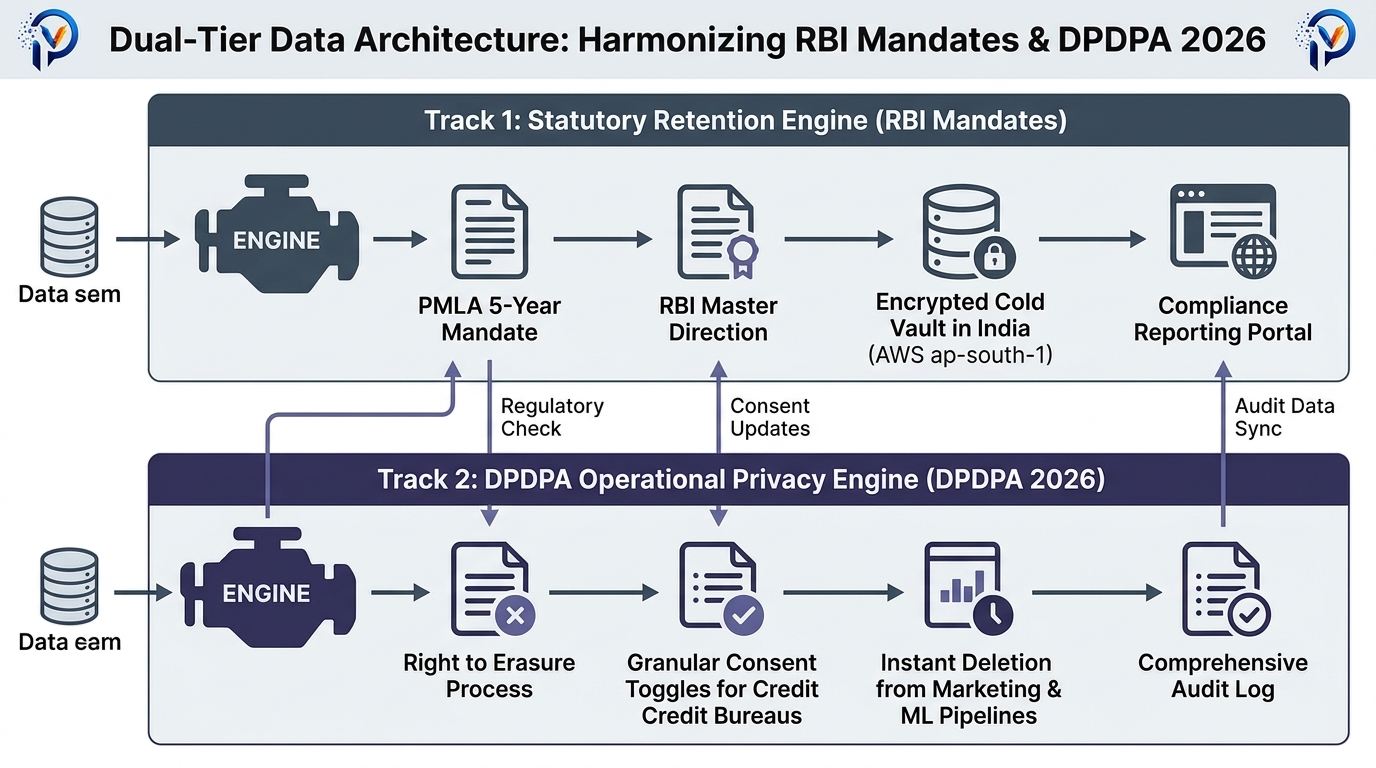
Architectural Implementation Steps:
- Track 1: Active Production Nullification — The user's active records in customer-facing relational databases (PostgreSQL/MySQL), analytics platforms (Mixpanel/CleverTap), and CRM pipelines are immediately pseudonymized or hard-deleted. No further commercial marketing or automated profiling may take place.
- Track 2: Statutory Cold Vaulting — Mandated KYC artifacts (Aadhaar XML references, PAN records, loan disbursement agreements) are compressed into an encrypted bundle and transferred to an immutable WORM (Write Once, Read Many) storage bucket (such as AWS S3 Glacier Vault with Vault Lock Policy enabled) located within India.
- Cryptographic Isolation — The cold vault encryption key is managed under strict Role-Based Access Control (RBAC) requiring dual approval from the Chief Compliance Officer and CISO, and is only accessed during formal ED or RBI regulatory audits.
- Automated Expiration Trigger — A deterministic lifecycle rule is configured:
retention_expiry = account_closure_timestamp + 5_YEARS. Once expired, the archive is permanently shredded with a cryptographic sanitization log.
Explore how the PrivacyOS Data Privacy Vault automates cryptographic tokenization and statutory cold vaulting for Indian fintechs.
Deconstructing Fintech KYC: Transitioning to Granular Purpose-Specific Consent (Sec 6)
For years, Indian digital lending apps and neo-banks onboarded users with a single omnibus clause: "By signing up, you agree to our Terms of Service, Privacy Policy, and authorize us and our lending partners to pull your CIBIL score, fetch KYC, and send promotional messages."
Under Section 6(1) of DPDPA 2023, bundled consent is explicitly invalid. Consent must be free, specific, informed, unconditional, and unambiguous with an affirmative action. Furthermore, Section 5 mandates that the notice be provided in clear language with an option to view in English or any of the 22 languages specified in the Eighth Schedule to the Constitution.
Compliant 4-Tier Consent Architecture for Fintech Onboarding:
Verification via DigiLocker / Aadhaar OTP strictly for account opening and credit underwriting.
Independent toggle to authorize soft/hard credit score inquiry with CIBIL or Experian.
Explicit consent to fetch bank account statements via licensed Financial Information Providers (FIPs).
Separate opt-in for promotional WhatsApp messages or pre-approved co-branded credit cards.
Integrate the PrivacyOS Consent Management Platform to log every user opt-in with cryptographic proof, timestamp, IP, and policy version.
Digital Lending Apps (DLG 2022) & Credit Bureau Hard Inquiries (CIBIL/Experian)
The intersection of RBI's Digital Lending Guidelines (DLG) dated August 10, 2022 and DPDPA creates strict operating boundaries for Regulated Entities (REs) and Lending Service Providers (LSPs):
- Prohibition of Mobile Hardware Scraping: DLG strictly banned apps from accessing mobile phone storage, contact lists, call logs, and media files. Under DPDPA Section 5, requesting contact permissions under the guise of "fraud detection" is an illegal purpose creep.
- One-Time Geolocation Access: Geolocation coordinates may only be captured once during onboarding to verify the borrower's presence in India for V-KYC compliance. Continuous background tracking without active loan servicing necessity is prohibited.
- Credit Bureau API Protocol: When pulling a credit score from Credit Information Companies (CICs - CIBIL, Equifax, Experian, CRIF High Mark), fintechs must obtain affirmative consent immediately prior to the API invocation and inform the user of the hard hit impact.
Payment Aggregators & Gateways: Card Tokenization (CoF) and Merchant Data Isolation
Payment Aggregators (Razorpay, Cashfree, PayU, PhonePe) process millions of credit/debit card transactions daily. Their compliance posture must satisfy both RBI Card-on-File (CoF) Tokenization directives and DPDPA data fiduciary rules:
- Tokenization Does Not Exempt Data from DPDPA: Under RBI mandates, actual 16-digit card numbers cannot be stored by merchants or payment aggregators; only authorized Card Networks and Issuing Banks store card PANs. PAs retain only the Token and truncated Last-4 digits. However, under DPDPA, a Token combined with a customer email/mobile is still Personal Data because it uniquely identifies a natural person. Token databases must be encrypted with AES-256 and access-audited.
- Merchant Data Segregation: Aggregators cannot use customer payment history from Merchant A to build algorithmic profiles or cross-sell loans to Merchant B's shoppers without independent customer consent. Multi-tenant database segregation must enforce strict row-level isolation.
Data Localization vs Cross-Border Transfers: RBI 2018 Mandate vs DPDPA Section 16
A common question asked by cloud-native fintechs is whether DPDPA Section 16 allows them to migrate their analytics cluster or customer data lake to AWS US-East or Google Cloud Singapore.
The Hierarchy of Laws: RBI Localization Supersedes DPDPA
While DPDPA Section 16 adopts a liberal "Blacklist" approach (permitting cross-border data transfer to all jurisdictions except those specifically restricted by the Central Government), Section 16(2) explicitly provides that DPDPA does not restrict the application of any higher standard of data localization provided under any other law. Because the RBI 2018 Data Storage Directive mandates 100% in-country storage of all payment system data, financial telemetry and payment records must physically reside in servers located inside India.
Incident Response Triad: Reconciling CERT-In (6h), RBI C-SOC (2-6h), and DPDPA (72h)
When a security incident occurs—such as an exposed API endpoint or leaked database credentials—fintech security teams must navigate three competing statutory notification clocks:
Under CERT-In Directions 2022, cybersecurity incidents must be formally reported within 6 hours of discovery.
Per RBI Master Direction on IT Governance, critical cyber incidents must be escalated to RBI C-SOC within 2 to 6 hours.
DPDPA Section 8(6) and DPDP Rule 8 require comprehensive breach intimation to the Board and all affected individuals.
Deploy PrivacyOS Incident Response Automation to pre-fill regulatory intimation packages within minutes of incident triage.
Third-Party Vendor Governance & Processor DPAs in the Fintech Supply Chain
Fintech platforms rely heavily on external Technology Service Providers (TSPs): OCR verification engines, DigiLocker gateways, facial biometric matching SDKs, and collection call centers.
Under Section 8(1) and Section 8(2) of DPDPA 2023, the Data Fiduciary (the Bank or Fintech) remains 100% legally and financially liable for any breach or non-compliance committed by its Data Processors. The argument that "the breach occurred on our vendor's servers" carries zero legal defense before the Data Protection Board.
Every fintech must audit vendor agreements and execute enforceable Data Processing Agreements (DPAs) that mandate:
- Prohibition of unauthorized sub-processing without prior written consent.
- Mandatory 2-hour security incident escalation to the primary Fiduciary.
- Annual VAPT and SOC 2 Type II audit compliance verification.
- Guaranteed storage of processed financial data strictly within India.
- Certified cryptographic data shredding upon contract termination.
Are You a Significant Data Fiduciary (SDF)? Criteria for Financial Entities
Under Section 10 of DPDPA 2023, the Central Government possesses the statutory authority to notify entities as Significant Data Fiduciaries (SDFs) based on volume of personal data, risk of harm to individuals, and national economic security.
Because commercial banks, major NBFCs, top Payment Aggregators, and large credit platforms manage critical economic telemetry, most established financial entities are expected to be designated as SDFs. This triggers three heightened statutory mandates:
- Appointment of a Resident DPO: A qualified Data Protection Officer physically based in India, reporting directly to the Board of Directors.
- Independent Data Audits: Periodic statutory data audits conducted by certified external auditors.
- Data Protection Impact Assessments (DPIA): Mandatory formal DPIA evaluations prior to deploying new lending products, AI credit scoring engines, or biometric systems.
Learn about our certified PrivacyOS DPO-as-a-Service & DPIA Advisory for Indian BFSI companies.
Interactive Tool: BFSI & Fintech DPDPA Readiness & Penalty Exposure Calculator
Use our interactive assessment calculator below to evaluate your fintech architecture against DPDPA 2026 mandates and RBI Master Directions, calculate statutory penalty risk, and generate an immediate CISO action roadmap: