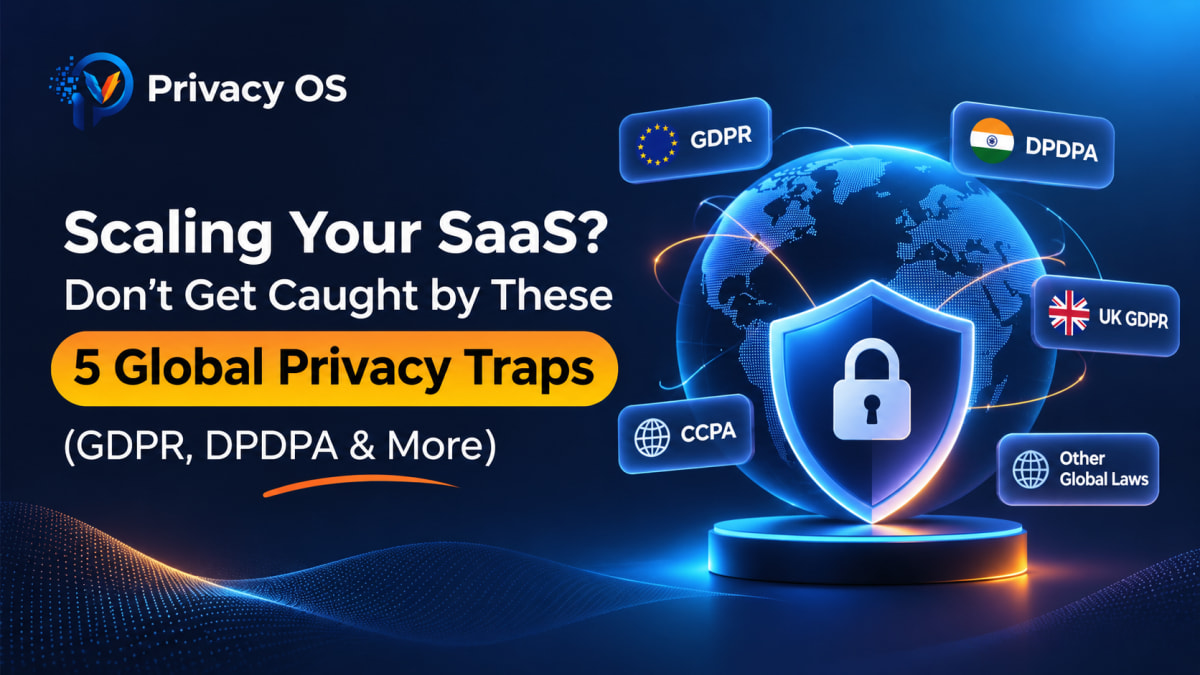
If you're a SaaS company, messing up global data privacy can cost you big. We're talking millions of Euros with GDPR — and India's DPDPA 2023? That's another source of hefty fines. But it's not just about avoiding those penalties. For quick-growing SaaS firms, getting global privacy right builds customer trust. It also opens up new markets for you. Miss the details of global SaaS privacy, especially GDPR and DPDPA stuff, and your expansion plans could crash fast. Seriously — don't let it happen.
Here's What We'll Cover:
- We'll break down the big differences between DPDPA 2023 and GDPR, especially for SaaS.
- How to actually bake global privacy rules into your SaaS product development. Practical stuff, not just theory.
- The five biggest mistakes fast-growing SaaS companies make with data privacy.
- Special things Gurugram businesses need to think about for compliance.
Global SaaS Privacy: What You Need to Know About GDPR, DPDPA, and More
Going global with your SaaS product? That means dealing with all sorts of legal rules. Every place handles personal data its own way. So, you get a tangled mess of rules for how you collect, process, and store information. Getting a handle on these basic differences is your absolute first move if you want to operate worldwide without trouble. Just knowing GDPR isn't enough. Rules like India's DPDPA are just as important.
These global privacy laws hit every part of your SaaS business. Think about it: from bringing on new users to handling customer support data. Mess this up, and you can't even work in big markets. Seriously, ignoring it costs big time.
- Where data lives? Totally different by country.
- How you get consent, and how easy it is to take back, changes a lot too.
- Data Subject Rights (DSRs) mean you need to respond fast and have clear processes.
- Moving data across borders? That always needs a close legal look.
- Local data watchdogs? They've got their own ways to enforce rules.
"Lots of SaaS companies just don't get how much work global data privacy actually takes. It's not just some legal checkbox you tick. This stuff needs to be baked right into your product design, your security, even your customer experience. Skip it, and you'll pile up technical debt. You might even get locked out of markets completely."
, Priya Sharma, Global Compliance Officer
Steps to build a strong global privacy setup
Look, getting your global privacy in order isn't a one-and-done thing. It's an ongoing process, you'll need smart planning and constant tweaking. Here's how to get a good base for your growing SaaS company.
- Map out all your data. Really dig into what personal data you're collecting. Where does it come from — where does it go? Who can see it? Knowing this is the absolute starting point for staying compliant.
- Get your consent process solid. Build consent systems that hit the highest global standards. Give people clear choices, make it simple to withdraw consent, too. This means supporting multiple languages and letting users pick exactly what their data is used for.
- Handle Data Subject Rights (DSR) smoothly. You need clear steps for handling requests. Things like access, correction, deletion, or data portability. Make sure you can do it all within the deadlines. Automation helps a ton when you're growing.
- Make data transfers safe. Moving data internationally? You've got to have the right legal protections ready. Think Standard Contractual Clauses (SCCs) or Binding Corporate Rules (BCRs). Don't skip this.
- Keep your privacy stuff updated. Laws change, right? So your compliance needs to change with them. Plan to regularly check your privacy notices, terms of service, and internal rules.
Comparing DPDPA 2023 and GDPR: Key differences for SaaS
Both the EU's GDPR and India's DPDPA 2023 want to protect personal data. But they do it differently — they have their own rules. If you're a SaaS company working in both places, you've gotta get these differences. Otherwise, you'll miss something important — want to really dig into India's rules? We've got a guide for that: check out our Dpdpa Compliance Saas Startups India Guide.
| Feature | GDPR (EU) | DPDPA 2023 (India) |
|---|---|---|
| Scope | It covers data processing for anyone living in the EU. Doesn't matter where that processing actually happens. | This one applies to digital personal data handled in India. It also applies if you're processing data outside India but offering stuff to people in India. |
| Consent | You need clear, 'yes' consent for most things. And people can take it back easily. | It needs a clear 'yes' action, too — and people can pull that back whenever. But it also talks a lot about "legitimate uses" where you might not need consent. |
| Data Protection Officer (DPO) | Public bodies, big data operations, or sensitive data? You'll need a DPO — it's a must. | No direct DPO rule here. But "Significant Data Fiduciaries", that's what they call certain companies, have extra duties. They even have to get an independent data auditor. |
| Cross-Border Transfers | Super strict rules. You're looking at adequacy decisions, SCCs, BCRs, all that stuff. | You can send data to pretty much any country. Unless the Indian government says no, of course. It's way less prescriptive than GDPR, for more info, check out the Ministry of Electronics and Information Technology (MeitY). |
Big Global Privacy Mistakes SaaS Scale-Ups Make
When you're growing fast, it's super easy to miss important details. Messing up here can mean big fines, a trashed reputation, and customers losing faith. Seriously, don't make these mistakes.
Mistake #1: Your 'one size fits all' privacy policy
Lots of SaaS companies try to use just one privacy policy for everyone, everywhere. But that just doesn't cut it for different places. Each region has its own rules, like how you're allowed to process data, how long you've got to respond to data requests (DSRs), or even what languages your notices need to be in. A general policy like that? It's usually breaking the rules in a bunch of countries.
- Not clearly stating local legal reasons for using data.
- No privacy notices in the right local languages.
- Missing specific local rules about getting permission.
Mistake #2: Forgetting about vendor and third-party risks
Your privacy rules don't just stop at your company; they cover every vendor and third-party service you use. If you've got a flimsy Data Processing Agreement (DPA) with a sub-processor, that could put you in serious legal trouble. Heads up: A lot of data leaks actually start with issues in third-party systems.
- Not checking out how third-parties handle data.
- Working with vendors who don't have proper DPAs.
- Not watching if vendors keep up their end of the deal after you sign a contract.
What You Get When You're Smart About Global Privacy
Look, think of global privacy as an opportunity. Not just some annoying burden — that mindset shift? It can really open up some serious business perks for you. Getting ahead on compliance actually makes your SaaS company stronger. And way more resilient.
- More Customer Trust: Show people you care about their data. They'll trust you more. This means they stick around longer, and your brand looks great.
- Easier Global Expansion: Compliance is like your passport. It gets you into new markets without annoying legal snags or delays. Pretty smooth, right?
- Less Legal & Money Trouble: Nobody wants huge fines or costly lawsuits. Avoiding those saves your bottom line — it protects what your company's worth. Plus, over 60% of consumers say they'll buy from brands they trust with their info. That's a big deal.
- Real Competitive Edge: You can totally stand out. Just offer better data protection than your rivals. In a crowded SaaS market, that's a massive differentiator.
- Smarter Operations: When your privacy processes are slick and automated, you cut down on manual work. Fewer mistakes happen, you save resources long-term. In fact, companies with automated DSR processes actually see a 30% drop in operational costs. Pretty cool, huh?
What Gurugram businesses need to know about global privacy
If you're a SaaS company based in Gurugram, Haryana, you're right in the middle of India's tech scene. This means DPDPA 2023 hits you for your Indian customers. But then there's GDPR and other regulations for your international clients. Your location means you've got to focus on two things: following Indian laws and handling global stuff at the same time. PrivacyOS Global, right here at Supermart, DLF Phase IV, Gurugram, really gets these local quirks and global needs. We help you bridge that gap.
How PrivacyOS Global makes global privacy simpler for you
PrivacyOS Global? It's a platform for data privacy and governance. It's built to handle all the tricky global rules. We help your SaaS scale-up hit those DPDPA, GDPR, and other regulatory marks without a fuss.
- Unified Consent Management: You can gather and manage consent in 22 languages. This makes sure you meet all sorts of global rules.
- Automated Data Subject Rights (DSR) Workflows: We make handling user requests for data access, deletion, and stuff like that way smoother. It cuts down on manual work and potential problems.
- Data Mapping & Inventory: Get a clear, live look at where your data goes. You'll spot and lessen privacy risks before they become big issues.
- Privacy by Design Integration: Build privacy right into how you develop products. It just makes following the rules a normal part of what you do. Our Dpdpa Compliance Platform has great features for this.
Ready to protect your business?
PrivacyOS Global gives you the full platform you need to handle all the tricky global data privacy stuff. Our tool helps you follow rules smoothly, build trust with your customers, and open up fresh market chances.
Contact PrivacyOS Global today for a free consultation →